What interests me across all my work as both a dramaturg and a playwright is how we not only tell women’s stories but how we interrogate with rigour who is telling that story, what stories are feeding into them and the angle from which a story is being told. It’s about depth and process and a constant vigilance around the ways in which our understanding of ourselves has been shaped through centuries of storytelling in which we were not involved in the recording or the selection.
I have been hugely inspired this year by Philippa Gregory’s book NORMAL WOMAN, which demonstrated to me how limited our popular storyhoard is in representing the historical lives of women: the upshot is, we don’t properly know who we are only who we have been told we are. I spent years for my play, the Commotion Time, trying to justify in my scene shapes putting women in key community roles in C16th only to discover through Katherine L. French’s brilliant study “The Good Women of the Parish” that their roles in parish institutions almost perfectly mirrored those of the women in parishes today – combining busy work and home lives with parish duties including organising events and leading wardenships. When I took back the play to the good women of the parishes of Poundstock and Week St Mary earlier this year, they were joyful at being represented on the page in a way they recognised as anchors and makers of community experience, and not in the way they’d expected, as subordinates. Then as now my story represents them as individuals fully engaged in the protection of their community institutions and the protests against their repression: the patriarchy existed and women’s lives were policed by it, but the variety of female experience, resilience, power and roles within society was not only wide but potent, active and impactful.
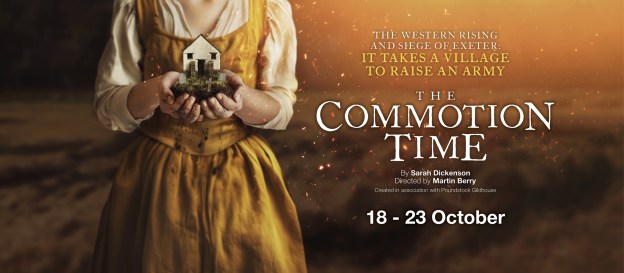
I started writing The Commotion Time twenty years ago, when Sandy Dingle, who with her husband Tim headed up the renovation of Poundstock Gildhouse, asked me to explore how a play could be written and performed as part of a renewed cultural offer for the building they were restoring. The renovation that Sandy and the other members of the committee oversaw was so successful it, according to the motion tabled in Parliament in 2012, “ was one of only three grand prix winners from across Europe in the 2012 European Union Prize for Cultural Heritage and Europa Nostra awards; [for] the restoration and preservation of the Gildhouse; and its [encouragement] of people from across the country to visit and experience one of the medieval days run by the local community throughout the year. Sandy, a former teacher, travelled to Portugal to receive this award from Placido Domingo. Thousands of local children now know more about themselves and their history as a result of the work she and the team had done and, incidentally, only this week was awarded an honorary degree from the University of Bedfordshire who determined that all women who earned PE teaching certificates from the Bedford College of Physical Education had in fact done the equivalent of a university degree. When I think about the impact that Sandy has had on her local community, young people around her, the church, our collective history and, on me as an artist, I think about the extraordinary activism of commitment and belief in people and place and our collective heritage and identity that she was curating, and other women like her continue to curate.
The Commotion Time has a run of only 7 days in Exeter this month, but the work to prepare it has been done by normal women for months and years: the women in a community choir who are learning new music, the women in the community chorus who are turning up every week committed not only to the experience but the importance of telling this story, the women in the Poundstock Gildhouse and surrounding parishes who have helped me to develop the play down to individual lines to ensure it represents and tells the truth, the women in the artistic/ producing/ marketing/ finance/ management/ everything teams at the Northcott who are supporting the telling of this story, the women in the professional cast who are making this play in a shorter time with such commitment. This is a great, collective act, of story making – a collaboration between hundreds of women – and people of all genders – harnessing their skills and passion and faith, to tell a story that has been all but forgotten from perspectives that have all been forgotten too.
And it is this great collaborative act of storymaking which The Commotion Time is about and this project is about too. Because The Commotion Time isn’t about my individual voice as a playwright – although it has been harnessed to shape and bring together the story – but is about the power of that collectivism and the challenge to us all in times of the polarisation of centralised change, of rebuilding our stories together.
The brilliant Brene Brown writes that “in the absence of data we tell stories”. I believe that our historical stories as women have been at the mercy of this absence of data and the stories we have been left with as a result. I also believe that the inaccuracy of data not only about the nature of women’s lives, but also the nature of their processes and the ways in which they produce and create, has also led to a set of stories that we live by but have also restrained us. Take for example the story about women not having enough confidence – the story goes that we need to be more empowered and we need find ways to build our confidence. But what if that lack of confidence was seen as a perfectly rational response to a system which didn’t enable you? I was recently diagnosed with ADHD after my son’s own diagnosis – one of thousands of women in their 40s misdiagnosed with depression/ anxiety when their neurodivergent signs were not noticed. Through my diagnosis I’ve begun to understand that my high sensitivity to rejection is part of my neurodivergent wiring and is a perfectly rational response to a world fraught with dangers. I’ve always been told I am too sensitive, but actually I am highly sensitive. I’ve always been told to be less sensitive. I can’t be. It’s my programming and denying me that essential part of myself also denies everything that makes me the creative I am. The alternative response is to acknowledge what my sensitivity is telling me and then working out how to manage that – and so as a dramaturg often working with women like myself, whose symptoms can be accentuated by menopause and other hormonal changes, I see suddenly that many of our artistic development system often don’t provide us with the tools we need to build our confidence – not in ourselves – but in the work we’re making. Doing that is straightforward – it’s about dialogue and checking in and other systemic changes that understands that the highly sensitive brains we need to see, document and change our worlds, need careful and connected and curious (more Brene Brown) systems to support them. This isn’t about mitigations, around 20% of us are highly sensitive, this is about systems that everyone benefits from.
So in my work I am conscious that not only are women’s stories not being told, but that when they are there can be a lack of data behind those stories because the premise upon which we understand women’s historical lives in our society incomplete and, often, the ways in which women are facilitated to tell their lives and stories are not always designed for them. As a writer and dramaturg, I am working across these things – with local communities (both on The Commotion Time and as part of O-Region’s From The Horses Mouth Project), on new productions of historical work with female playwrights seeking to unearth women’s stories (Princess Essex by Anne Odeke at the Globe and the Women’s Prize For Playwriting winner, Intelligence by Sarah Grochala, for Ellie Keel and Paines Plough), as a co-writer (on new musical Everything’s Fine with Sam Hodges and pop writers Miranda Cooper, Jason Pebworth and Jon Shave) and dramaturg of contemporary work by female writers (The Woman and Belongings by Jane Upton, Wrestle Lads Wrestle by Jennifer Jackson). All of this work is interconnected both in its focus on women’s stories and, critically, the process by which is realised.
When I listened on audiobook to Philippa Gregory’s description of how, after the black death, women and men had equal pay in England – I felt a moment of absolute rage (rage that kept coming throughout my listening to that book and its documentation of the control of women for centuries) – it dawned on me how powerful a control this forgetting of ourselves was. Similarly when I received my own ADHD diagnosis last year I had rage too – this time because I realised that I had not really belonged to myself for many years because I fundamentally didn’t understand that my brain was different – only that I was a bundle of shameful diagnosis of depression, anxiety, low self esteem, over-sensitivity, extreme pmt, post-natal depression and so on. The Commotion Time comes at the end of my own Commotion Time at a time when I finally feel like I belong to myself as a neurodivergent person and as a woman whose history is more nuanced and complicated that I could every have imagined. These things have empowered me and I am now determined in the work I do as a playwright and a dramaturg to continue to harness and evolve this understanding so others might be too.
‘The story is not told to lift you up, to make you feel better, or to entertain you, although all those things can be true. The story is meant to take the spirit into a descent to find something that is lost or missing and to bring it back to consciousness again.”
Clarissa Pinkola Estés
 Sarah Dickenson